As the new century dawned the McCorkells were well established in Donegal and Londonderry. The period after William's victory at the Boyne became known as the Protestant Ascendancy. Power passed to the great landlords, churchmen and professions, all members of the Anglican Church of Ireland. Catholics, and to a lesser extent Presbyterians, were excluded from power, and harsh penal laws were passed to prevent "the further spread of Popery".
Presbyterians had grown strong through trade, especially in the towns and above all in Londonderry, which the landed classes resented. In 1704 the Sacramental Test was introduced in Ireland: every holder of public office, civil or military, had to take communion in the Church of Ireland. Twenty-four Presbyterian members of the Londonderry corporation resigned rather than comply. The Toleration Act of 1719 granted Presbyterians freedom of worship, but their sense of estrangement from the Anglican establishment remained, and it fed the great emigration of the eighteenth century.
That was not the only cause. Many of the cheap leases that had drawn Scots to Ulster ran out around this time, and landlords raised rents sharply, making Ulster a far less attractive place to put down roots. The emigrations of these years are covered in Chapter IV.
The early 1700s
Few records survive from the early part of the century, so it is hard to connect the families of the 1600s with those in the 1740 census. These are the entries I have found:
George Mackorkle, ship's surgeon
The National Archives at Kew hold the Admiralty's record of George Mackorkle, surgeon of the frigate Fly, with his salary for 1 July 1706 to 30 June 1707, and a letter from him dated 18 April 1709 asking to be released from service. I believe he is George McKorkel, baptised at Burt in 1681, son of Robert McKorkel, who was probably the Robert McCorkle, “gent”, of the will of 1691. A family of means would have been able to educate a son to become a ship's surgeon.
Andrew McCorkell of Ballyhaskey
In 1707 an Andrew McCorkell made a will in the Barony of Raphoe; no other details survive. In 1708 an administration bond was entered in the diocese of Raphoe for the estate of Andrew McCorkill of Manorcunningham, deceased. It is listed in the index of testamentary bonds, not the marriage bonds, as I once thought, and the will of 1707 may concern the same man. An Andrew McCorcle married Martha Finaly at Burt in 1709; if the Manorcunningham Andrew was dead by 1708, this was a younger Andrew, perhaps his son.
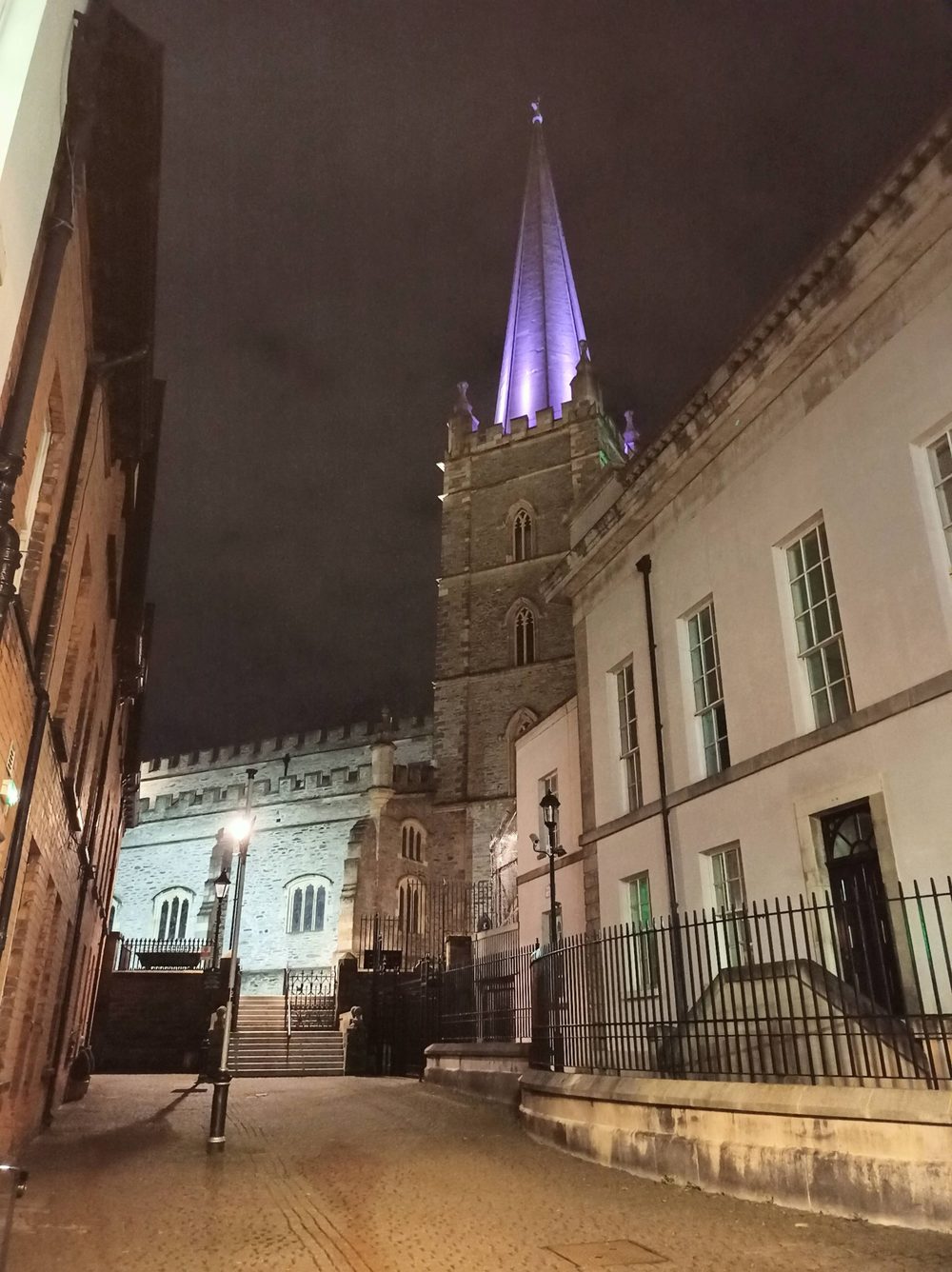
On 14 December 1715 Adam, son of Andrew McCorkle and his wife Mary, was baptised at St Columb's Cathedral in Derry. Before this every McCorkell I have found was Presbyterian, but the Church of Ireland was the only legal church for most of the century, and many Presbyterians and Catholics married or baptised there while still worshipping in their own meeting houses.
In July 1727 a survey of the Forward estate mapped Ballyhaskey, All Saints parish, the same townland as Andrew M'Corckle in the 1660s, and records Andrew McCorkle as its first tenant. His house is drawn at the top of the townland, about where All Saints Church and Colehill Park stand today, which makes it very likely he was related to the earlier family, perhaps a son of Robert McCorkell, who left his will from Cullmactraine in 1691.
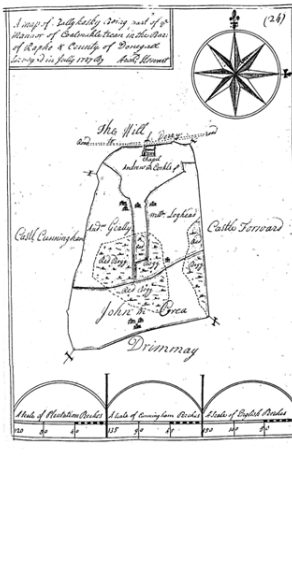
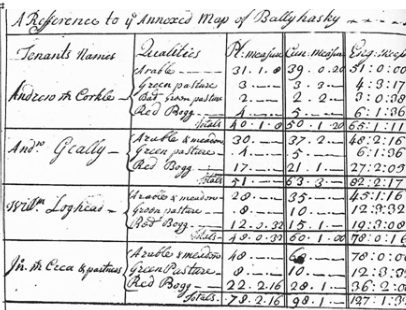
The map's title describes Ballyhaskey as part of the manor of Coolmactrean, the Cullmactraine of Robert McCorkle's will and the Coole McTreene where Sir James Cunningham died in 1623. Almost a century after Andrew and John mustered for Lady Cunningham in 1630, an Andrew McCorkle was still farming the old Cunningham lands.
I believe this is the same family that appears in the Hearth Money Rolls. The Andrew of Ballyhaskey in 1727 cannot be the Andrew of Manorcunningham whose estate was administered in 1708, but he may well be his son, and perhaps the Andrew who married at Burt in 1709.
The family was still in the neighbourhood a generation later. A deed of the early 1760s names a Thomas McCorkell, paying £2 12s a year, among the tenants of the lands of Erraty, next to the quarterland of Dromochill. That is the Drummochill where a Margaret McCorkle’s will was indexed in 1761. Both places are probably near Drumoghill, in Raymoghy parish, a few miles from Manorcunningham, though the townland names in the deed are a machine reading and still need checking.
The 1740 Protestant census
Probably as a result of the first great emigration, the Irish Parliament ordered a census of Protestant householders in 1740. The originals were destroyed in 1922, but copies survive for some parishes, luckily for me including most of those where I would expect to find McCorkells. Unfortunately the parishes of the Barony of Raphoe do not survive, so families are probably missing. Ballyhaskey does not appear in later records, and that branch may have emigrated or moved north in the mid-1700s.
| Name | Townland | Parish | County |
|---|---|---|---|
| Joseph McCorkill | — | Templemore | Donegal |
| Arsbel McCorkill | Carrownamaddy | Templemore (Burt) | Donegal |
| James McCorkill | Speenoge | Templemore (Burt) | Donegal |
| William McCorkill | Mulleny | Templemore (Burt) | Donegal |
| Robert McCorkill | Ballymacarthur | Moville | Donegal |
| Joseph McCorkill | Goorey | Clonca | Donegal |
| Patrick McCorkill | Ballyartan | Cumber | Londonderry |
| James McCorkill | Kilcattan | Cumber | Londonderry |
For the first time since the 1660s I can place these men in their townlands, which makes identifying their descendants much easier. Arsbel, presumably Archibald, at Carrownamaddy echoes Aaron McCorcell "of Carnamaddy" baptised at Burt in 1683.
Freeholders and the city
| Year | Record |
|---|---|
| 1746, 1760 | James McCorkle pays cess in Butcher Street, Londonderry. |
| 1749 | Margot McCorkell buried at St Columb's Cathedral. |
| 1761 | William and David McCorkle, freeholders, Altaghaderry, Co. Donegal. |
| 1763 | George McCorkle sues John Gormley for debt in the Mayor of Londonderry's court, 11 June (writ at PRONI). |
| 1768 | Joseph McCorkle registers his freehold at Altaghaderry, 14 April. |
| 1775 | David McCorkell, innkeeper, of the City of Londonderry, witnesses a deed of Mathew Grave to his son Walter Grave of Altaghaderry, 30 January. |
Altaghaderry is in the parish of Killea, on the border with County Londonderry, within five miles of the city. Joseph and William may be the Joseph and William of the 1740 census for Templemore. McCorkells were still in the parish in 1901, at Whitehouse and Haw (Chapter V).
The Altaghaderry freeholders held their land on leases for lives, which put them above most tenant farmers of the time. In 1775 a David McCorkell, innkeeper in the city, witnessed a deed concerning Altaghaderry, and William, founder of the shipping line, was also a Derry innkeeper in the 1770s. The two Williams and two Davids may be the same men, which would make Altaghaderry the origin of the shipping family; see Chapter V.
The Londonderry Journal and the shipping line
The Londonderry Journal began publication in 1772, and McCorkells appear in its pages from the start:
| Year | Entry |
|---|---|
| 1772 | William McKorkell, innkeeper, of the Bogside |
| 1773 | William McCorkell, innkeeper; Will McCorkel, Bogside; Widow McCorkill, Bogside |
| 1775 | William McCorkel, Londonderry city, signs the Dissenters' Petition |
| 1779 | David McCorkle, living near the Linen Hall |
| 1781 | Mrs Ann McCorkell, Bogside |
| 1784 | William McCorkell in possession of a tenement in the Bogside |
William McCorkell the innkeeper is almost certainly William McCorkell, founder of the McCorkell shipping line. His death is recorded in the Belfast News-Letter of 2–6 February 1795 (page 3): "Died – in the Bog side in the 74th year of his age, Mr. William McCorkell". That puts his birth about 1721, but the family gravestone at St Columb's gives his age as 67, which would put it about 1728; the two sources cannot both be right. His descendants, the Shipping McCorkells, are followed in Chapter V.
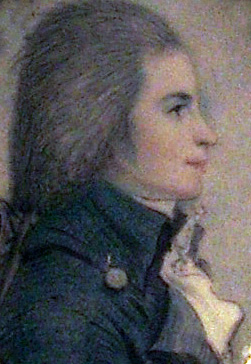
His son, also William (1772–1836), took over the running of the Journal with fellow Presbyterian John Buchanan in 1796, and in 1797 became the first McCorkell to be made a freeman of the city. In September 1799 the Belfast News-Letter listed him, as "Wm M'Corkell", among the grand jurors of the city and county of Londonderry at the summer assizes who signed a declaration in support of the proposed Union with Great Britain. His father had kept an inn in the Bogside; within four years of his death the son sat on the county grand jury.
Three clusters
By the late 1700s there were three or more clusters of the name. The largest was in the Donegal hinterland of Derry, mainly in Burt and Killea, with a few members established in the city who would play an important part in its commerce and industry in the next century. The second, almost all farmers, was on the north coast of Inishowen around Malin and Greencastle, seen in the 1740 census, and later generations there probably descend from them. The third was around Strabane and Cloughfin, in the papers of the Abercorn estate.
The Abercorn papers
The Abercorn estate papers at PRONI record a dispute in March 1778 over lime: the Cloughfin tenants wanted to take it from Mr Carey's farm as they always had, while McCorkill said there was lime on his own farm, but it lay deep. In the estate survey of 1781 Samuel and William McCorkle hold leases at Cloughfin, parish of Clonleigh, in the south of the Laggan.
On 11 May 1783 the agent wrote that William McCorkill of Cloughfin, whose new rent was £11, had come in with James Pinkerton, a substantial tenant and distiller of St Johnstown, saying he had agreed to sell Pinkerton his farm for £15, though the agent believed it was more. He added that young men from the town were taking linen to America and some tradesmen were going to settle there, but he hardly thought McCorkill would go, "as he is an elderly man". The hint that he might have been leaving for America is intriguing.
Six years earlier a “Wm. M’Corkel, St. Johnstown” had subscribed to James Poulson’s Observations on Various Subjects (1777), alongside subscribers from Londonderry, Muff and Coleraine. Cloughfin lies between Lifford and St Johnston, and he was very probably the same William. A man who bought books by subscription was no ordinary tenant farmer.
Late in the century
| Year | Record |
|---|---|
| 1786 | Died, George McCorkell of Burt. Belfast News-Letter, 7–10 November, page 2. |
| 1791 | Will of George McCorkill, mariner, "late of Londonderry in the kingdom of Ireland but now in London". He leaves his wages, money and lands equally to his sisters Sara, wife of Peter Blyth, and Mary McCorkill, spinster, "both now or late of Londonderry". The executor is a Mr Cullin of Wapping Street. Held at the National Archives, Kew. |
| 1794–95 | James McCorcle (1794) and Joseph McCorcle (1795), churchwardens of Killea parish church. |
My body I commit to the earth or sea as it shall please God to order.Will of George McCorkill, 1791
The words are a seaman's, and so is the executor: Wapping, on the Thames below the Tower, was the sailors' quarter of London, full of lodging-house keepers and agents who handled seamen's pay. George was clearly unmarried and childless, with no closer family than his two sisters in Derry. He may have been a son of George Mackorkle the ship's surgeon; I can find no baptisms for him or his sisters.
A churchwarden was not necessarily a member of the Church of Ireland. Under the Ascendancy the parish vestry also handled civil business, such as the county cess, and Presbyterians could and did serve on it. A historian at PRONI confirmed this to me. The same applies to William McCorkell, churchwarden at Moville in 1792, whose branch stayed Presbyterian.
The Flax Growers' Bounty, 1796
The Linen Board's bounty list of 1796 is one of the best census substitutes for the end of the century. Tenants were given four spinning wheels for each acre of flax sown, and a loom for five acres, so almost every tenant farmer appears. The names are listed by parish only, but the list shows how the name had spread over a hundred years.
| Name | Parish | County |
|---|---|---|
| Andrew M'Corkil | Templemore | Donegal |
| Manus M'Corkil | Kilbarron | Donegal |
| Patrick M'Corkil | Clonleigh | Donegal |
| Mary M'Corkill | Templemore | Donegal |
| James M'Corkle | Tullyaughnish | Donegal |
| John M'Corkle | Conwal | Donegal |
| Robert M'Corkle | Rye | Donegal |
| James M'Corkell | Fahan Upper | Donegal |
| William M'Corkle | Fahan Upper | Donegal |
| William M'Corkle | Moville Upper | Donegal |
| Alexander M'Corkle | Tamlaght Finlagan | Londonderry |
| Andrew M'Corkle | Templemore | Londonderry |
| Thomas M'Corkle | Templemore | Londonderry |
| William M'Corkle | Tamlaght Finlagan | Londonderry |
| Peter M'Corkill | Dromore | Tyrone |
William M'Corkle of Moville Upper is my 5x great-grandfather, the William of Curraghnagarry whose story is told in Chapter V. In all there were ten McCorkell farming families in Donegal and four in Londonderry, though Templemore straddles the county border.
The family stayed in Tamlaght Finlagan: the 1831 census of County Londonderry lists Robert, Thomas and William McCurkle at Drumacarney, and a William McCorkle at Carnowry in Magilligan, across the Foyle from Greencastle. The same census of County Londonderry shows many Inishowen names in that district, which is not surprising given the ferry between Greencastle and Magilligan, and Alexander and William almost certainly came from Inishowen. Peter M'Corkill at Dromore is well outside the usual area, perhaps a later arrival from Scotland. In the early nineteenth century another McCorkle family came directly from Paisley to Loughgilly in County Armagh; see Chapter V.
Into the nineteenth century
The McCorkells of Aughnish, near Ramelton
One family of the name was settled near Ramelton, on Lough Swilly. In the Flax Growers' Bounty of 1796 a James M'Corkle farmed in the parish of Tullyaughnish, and his son Isaac was described thirty years later as the son of "Mr. James McCorkell, near Ramelton". A Mrs Margaret McCorkell died at Aughnish, near Ramelton, on 16 January 1842, in her 82nd year. Born about 1760, she may well have been James's wife and Isaac's mother.
Isaac McCorkell, M.D., was born in Donegal on 21 May 1795. He served as a surgeon in the militia and went out to Jamaica. By 1824 he was surgeon of the Manchester Regiment of the island militia and an assistant judge of the Court of Common Pleas and magistrate for the parish of Manchester. He was not the only McCorkell there: a George McCorkell, planter, was quartermaster of the same regiment from February 1823. Among the regiment's other officers was an Ensign Andrew B. Delap, probably of the Delap family of Ramelton, who had long-standing Jamaica interests. Ramelton men may well have followed one another out.
On 19 May 1824 Isaac married Ann Smith, born in Kingston on 27 July 1805. She was a daughter of Robert Smith, a Scot who rose to be city treasurer of Kingston and a judge, and of Hannah Moore Carpenter, a descendant of Samuel Carpenter, one of the founders of Philadelphia. That is why the family is recorded in Samuel Carpenter and His Descendants, published in 1912. When their first son was baptised at Kingston in 1825 the register called the parents "Isaac McCorkell … and Ann his wife, late Smith, spinster".
On the 27th Oct. last, at Vere, Jamaica, aged 33 years, Mr. Isaac McCorkell, surgeon, son of Mr. James McCorkell, near Ramelton, very much regretted by all who knew him.Londonderry Sentinel, 4 February 1832
The Carpenter book gives his death as 10 October 1831, the newspaper as 27 October. The newspaper's age of 33 also disagrees with a birth in May 1795, which would make him 36. One of the two is mistaken. Ann outlived him by more than thirty years and died in Kingston on 30 March 1864.
Isaac and Ann's family
| Child | Born | What is known |
|---|---|---|
| Robert David Thompson McCorkell | 22 Feb 1825 | Baptised at Kingston, 7 July 1825. Married; one daughter, Ann. |
| William McCorkell | 20 Feb 1826 | Born in Manchester parish. Sugar planter. Married Arabella Bauchs Edwards of Liverpool, 9 December 1852. Died at Abbeville, France, 8 March 1887. |
| James McCorkell | 25 Jul 1827 | Baptised in Manchester, 26 September 1827. Died at Hopewell, 5 October 1828. |
| Isaac McCorkell | 22 May 1829 | Died 12 February 1842 at St Andrew, aged 12. A memorial inscription to him was published in 1875. |
| Duncan Robertson McCorkell | 12 Jul 1830 | Baptised in Manchester, 19 May 1831. A sailor; "went to Brazil and was never heard from again". |
Only William is known to have carried the line on. He and Arabella had seven children, the first three born in Jamaica: Catherine Frances (1853–1854), William Smith (born 1854), Trevor Bauchs (1855–1856), Harry Mostyn (born 1860), Geraldine (1862–1891), Theodora (born 1864 at Islington) and Ethel (born 1866 at Peckham Rye). By the mid-1860s the family had moved to London, and in the 1871 census William, "sugar planter", born in Jamaica, was staying at Camberwell with ten-year-old Harry. William Smith McCorkell married a Miss Mundy; Harry married in 1885; Geraldine married Thomas Flynn in 1886 and died in Dublin. The Carpenter book says of Harry's and Geraldine's children only "had issue, no records", so descendants of the Ramelton surgeon may well be living in England or Ireland today.
George McCorkell had a daughter, Margaret, baptised in the parish of St Elizabeth on 10 September 1813; her mother was Elizabeth Clarke. Manchester was carved out of St Elizabeth the following year, so this is very probably the same George. How he was related to Isaac is not known.
Vere and Manchester were plantation parishes, and a doctor and magistrate there in the 1820s lived among the estates and the enslaved people who worked them. The Legacies of British Slavery database at University College London shows that Isaac was more than a neighbour to that system. From about 1822 he was joint owner, with an attorney named Ralph Thompson, of the Christiana estate in Manchester. In 1823 about 65 enslaved people were bought for it from the heirs of Robert Shaw, who had held them at Shaw's View in St Dorothy. By 1832 there were 76 people on the estate. Christiana was too hilly and its workforce too small for sugar, and was more likely a coffee, pimento or livestock property. After slavery was abolished and the owners compensated, Ann, as Isaac's executrix, claimed £1,529 1s 5d for 75 people on Christiana in 1837. The claim failed: the money went instead to the estate of the mortgagee, John Biggar. Ann was still proprietor of Christiana, 904 acres, in 1840. The records give the numbers of the people held there but not their names.
Several of those enslaved in the parish carried the surname too. Between 1820 and 1824 six people surnamed McCorkell were baptised in Manchester with no parents named. One of them, "Doctor Isaac McCorkell", baptised on 30 December 1821, is entered in a list of enslaved people, as belonging to Kendal property. Their surname may have come from the doctor rather than from any family tie, and anyone of Jamaican descent with the name may find their origins here rather than in Donegal.
So at the close of the eighteenth century the family was firmly established in the north-west, confined almost entirely to Donegal and Londonderry. Emigration to North America continued, though less than in the middle of the century, and in the 1800s Australia became a destination too. Almost no ship lists survive from the 1700s, and those of the 1800s are far from complete. The number of McCorkells in North America and Australia shows that many made the journey, but connecting them to the families left behind is difficult.
Open questions
- Was George Mackorkle, surgeon of the Fly in 1706–09, the George baptised at Burt in 1681, and was George the mariner of 1791 his son?
- What became of the Ballyhaskey family after the survey of 1727?
- How was George McCorkell, planter, of Manchester, Jamaica, related to Isaac the surgeon, and was Mrs Margaret McCorkell of Aughnish (d. 1842) Isaac's mother?
- Did William McCorkill of Cloughfin go to America after selling his farm in 1783?
- Was the founder of the shipping line born about 1721, as the Belfast News-Letter implies, or about 1728, as his gravestone says?
Sources
- Legacies of British Slavery database, University College London: Isaac McCorkell.
- Edward Carpenter and Louis Henry Carpenter, Samuel Carpenter and His Descendants (Philadelphia, 1912), entries for Ann Smith and her McCorkell children and grandchildren.
- Jamaica, Church of England parish register transcripts, 1664–1880, and Jamaica births and baptisms, 1752–1920 (FamilySearch): Kingston, Manchester and St Elizabeth.
- Jamaica Almanac, 1824 and 1840; census of England and Wales, 1871, Camberwell.
- The National Archives, Kew: Admiralty records, ADM 106/2952 and ADM 106/2960 (George Mackorkle); will of George McCorkil, 1791.
- Protestant Householders' Census, 1740 (surviving copies).
- Forward estate valuation, 1727.
- Abercorn estate papers, PRONI (D623).
- Londonderry Journal, 1772–84; Belfast News-Letter, 7–10 November 1786, 2–6 February 1795 and 24 September 1799.
- Londonderry Sentinel, 4 February 1832 (death of Isaac McCorkell) and 21 January 1842 (death of Margaret McCorkell).
- Flax Growers' Bounty List, 1796.
- Northern Ireland Buildings Database: house on Bishop Street Within at St Columb’s Court, built 1768 for the Honourable The Irish Society.