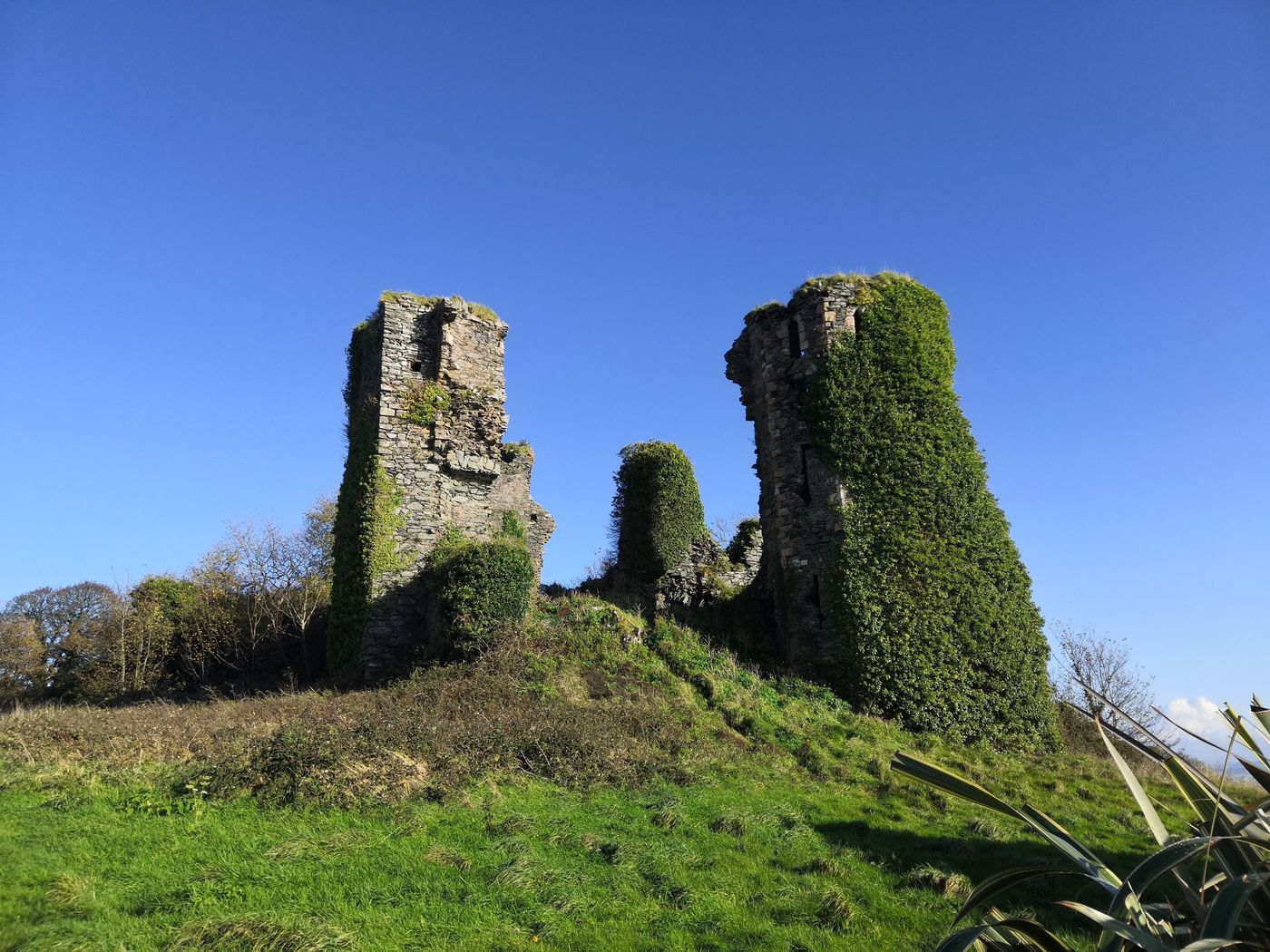
In the middle of the nineteenth century Ballymacarthur, near Greencastle, was still full of McCorkells. On a map of Inishowen of 1661, the earliest yet found to name it, the townland is “ballyarthur”, lying between “bally lchan” (Balleeghan) and Greene Castle; its official Irish form today is Baile Mhic Artúir. Who the Arthur was is not known. It is said locally that the name comes from Sir Arthur Chichester, who was granted Inishowen after Sir Cahir O’Doherty’s rising of 1608 (see The Plantation), but no source for this has been found, and the name may well be older: the Anglo-Norman castle stands right beside it. The area held more of the name than anywhere else in Ireland: over a hundred McCorkell births were registered in the Moville district between 1834 and 1898. Griffith's Valuation of 1857 lists Archibald and John McCorkell there, with George at Carrowtrasna and William at Balleeghan nearby, and the Moville Presbyterian registers show several families raising children in the townland:
| Parents | Children baptised |
|---|---|
| George McCorkell, farmer, of Ballymacarthur | No baptisms in the register; named as father of John at John's marriage to Isabella Baird, 1845 |
| George McCorkell and Anne Gamble | Sally (1841), Peggy (1842) |
| William McCorkell and Elizabeth Jane Smyth | Jane Ann (1846), William (1848), George (1849), John (1850), Thomas (1853), Joseph (1854) |
| John McCorkell and Isabella Baird | Robert (1850), James (1852), John (1854), William (1857), Ann (1859), Sarah (1862) |
| Archibald McCorkell and Sara Anne Burns, married 1858 | William (1858), Margaret (1860), Sarah (1863), Elizabeth (1865), Ann (1868), Archibald (1870), James (1873), Catherine (1875), John (1877), George (1881), Herbert (1882) |
One of the daughters, Elizabeth, died in Philadelphia on 24 November 1890. Her death notice calls her “daughter of Sarah Ann and Archibald McCorkell, of Green Castle, County Donegal, Ireland”, and her funeral was held from the house of her brother-in-law, Samuel G. Wittaker, so a sister had married there too. The notice gives her age as 22, but the Elizabeth in the table was baptised in 1865: either the age is wrong, or this is Ann (1868) under another name.
William McCorkell and Betty Smyth later lived at Greencastle. William was born about 1815; the couple are said to have had thirteen children, the youngest being James William McCorkell, born at Greencastle on 21 September 1859. William died there on 18 September 1895.
William of Greencastle and William of Ballyrattan, born in 1807, were near contemporaries living a short distance apart, and both families probably descend from the Robert McCorkell of Ballymacarthur recorded in 1740 and 1774. Whether they were cousins, or closer, is not yet known. The baptisms place his family firmly at Ballymacarthur.
Three Greencastle families
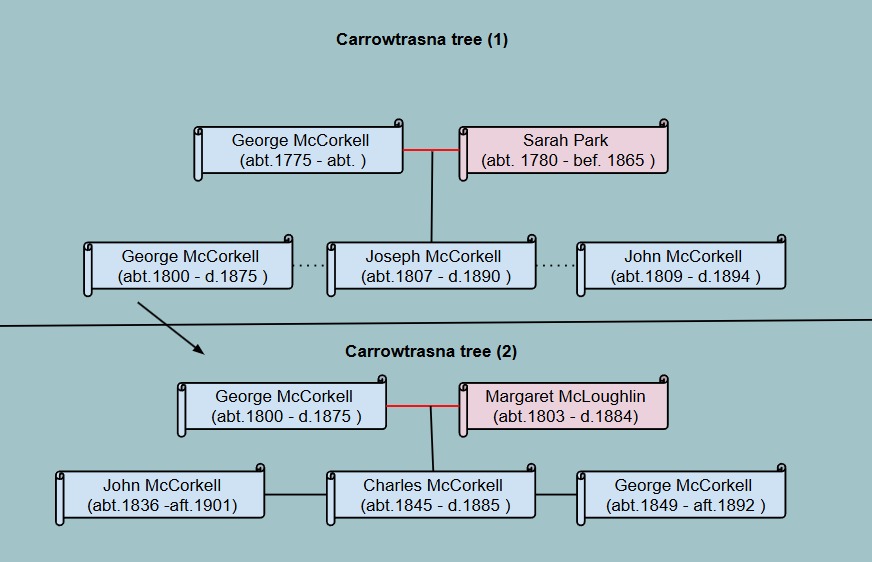
My working tree of the Inishowen McCorkells groups the families around Greencastle into three lines, all probably descended from the Robert McCorkell of Ballymacarthur who is in the census of 1740 and the parish cess of 1774. The links between the generations before 1800 rest on naming patterns and townlands rather than records.
- George McCorkell and Sarah Park, married about 1799. A “Geo. McCorkle” signed the County Donegal declaration in favour of the Union in January 1800, in a list of Inishowen names from Malin, Lagg and Carnmore; he may well be this George. Joseph (c. 1807–1890), who married his cousin Ann and took his family to Glasgow, is their documented son. Ann’s parents were probably John McCorkell and Agnes Hutcheson. When their daughter Sally was baptised in 1834 their home was written “Callowdrain” or “Fallurcham”, surely Falladreen, the place-name the valuation map marks next to George’s farm at Carrowtrasna. Two more men were probably his brothers: George (c. 1800–1875), who farmed lot 22 at Carrowtrasna, in the clachan of Falladreen, where the lane up to the house is still called McCorkell's Road; and John (c. 1809–1894), who married Isabella Baird in 1845 and farmed at Ballymacarthur. George married Margaret McLoughlin, and their sons were John (c. 1836), Charles (c. 1845–1885) and George (c. 1849), who went to Brooklyn. Charles married Mary Lynch at Culdaff in 1873, and this branch became Catholic.
- William McCorkell and Sarah Walker. William paid tithe at Ballymacarthur in 1825. Their son William (c. 1815–1895) married Betty Smyth and lived at Balleeghan; their daughter Jane Ann married John Monteith in Ohio about 1870. My earlier tree also made Archibald, who married Sara Anne Burns in 1858, their son, but that is now doubtful (see below). A daughter, Margaret, married Robert Clark and died at Paisley in 1895. Cousin marriages were common: John McCorkell married Jane McCorkell, daughter of William, both of the same townland, at Moville Lower on 15 September 1855.
- John McCorkell and Agnes Hutcheson, married at Moville about 1809. Their son John (1811–1888) married Mary Ann Martin and took the family to Paisley, where they were known as McCorkindale. He died in the Burgh poorhouse there in 1888. His son Archibald married Agnes Douglas at St Finian's, Greencastle, in 1879, and died at Boston in 1883, aged 27. Their son John, born at Boston in 1880, grew up at Ballyrattan with his widowed mother (see Ballyrattan).
The rental of 1850
Ballymacarthur was sold in the Encumbered Estates Court in 1850 as Lot 4, “the Lands of Ballymacarthur, situate in the Barony of Inishowen”, and the printed rental lists every tenant. All held from year to year. Four were McCorkells: Robert McCorkell (no. 20), George McCorkill (no. 34), and two Archibalds on separate farms, Archibald McCorkill, Jun. (no. 38) and Archibald McCorkill, Sen. (no. 41). The same rental was filed again in 1851. George and John McCorkell are in the rental of Carrowtrasna in the same years.
The four Archibalds
Archibald was the commonest name in the Greencastle families after William and John, and four men of the name have been confused in the past, my own earlier tree among them. They can now be told apart.
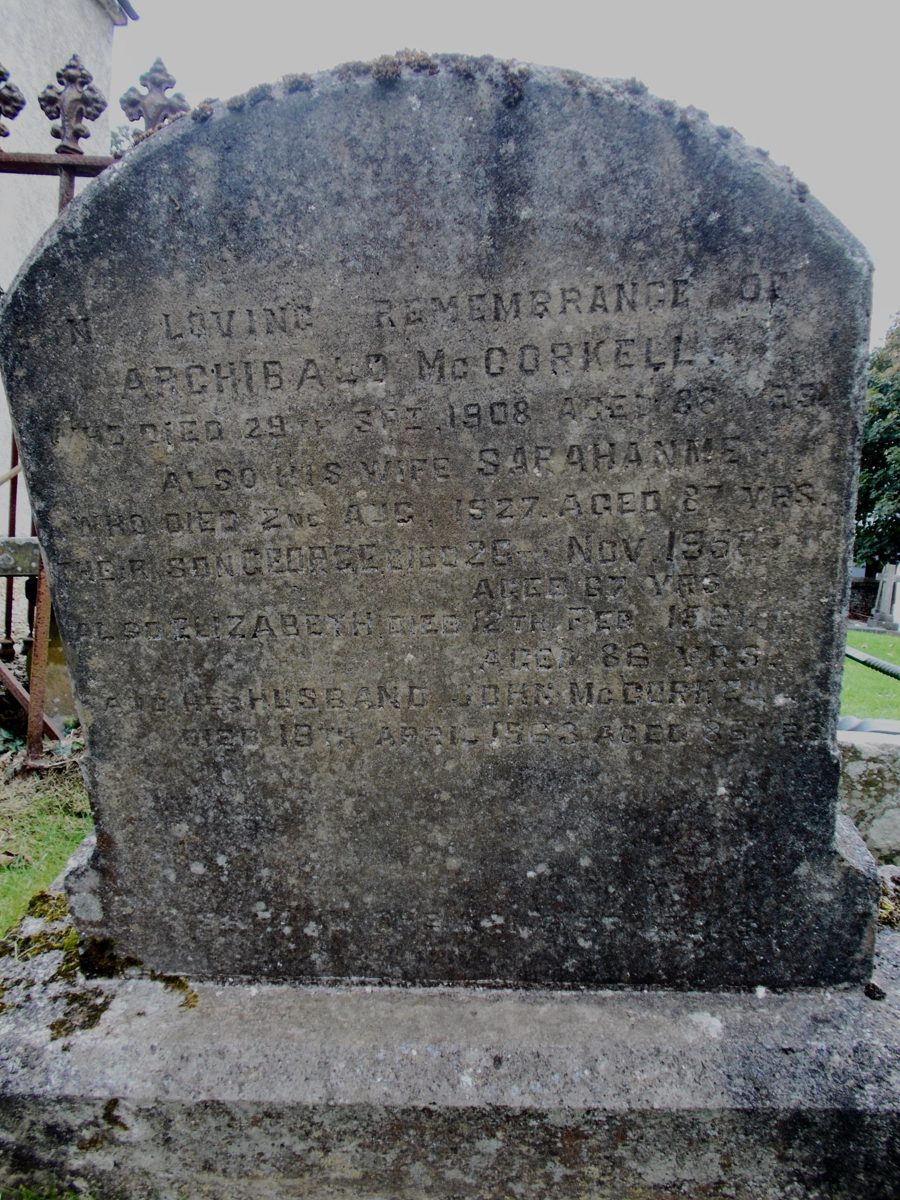
- Archibald McCorkell senior (the “Jun.” of the 1850 rental, senior only to his own son), born about 1820 at Ballymacarthur, a farmer, married Sara Anne Burns in 1858 and raised eleven children there; he died at Ballymacarthur on 29 September 1908, aged 88, and Sara Anne on 2 August 1927, aged 97. Their headstone at St Finian’s, the parish church at Greencastle, also names their son George (1881–1950) and their son John (1877–1963) with his wife Elizabeth, known as Lizzie, born Quigg, who died in 1961. The probate calendar gives Archibald’s death as 24 September, but the civil registration and the headstone both have the 29th. His parents are uncertain. A baptism of 1820 names an Archibald McCorkell and Elizabeth Moore, and my earlier tree named William McCorkell and Sarah Walker. The rental of 1850, with an Archibald senior and an Archibald junior holding separate farms in the townland, fits the baptism better: the elder was very probably his father.
- Archibald, his son, born at Ballymacarthur on 3 June 1870. He went to Philadelphia about 1894, and again in 1902, married Maggie Knox there in 1900 and settled at Upper Darby; he died in 1947.
- Archibald of Boston, born about 1856 at Greencastle, son of John McCorkell and Mary Ann Martin, married Agnes Douglas at St Finian’s, Greencastle, on 2 November 1879, and died at Boston on 2 November 1883, aged 27.
- Archibald the gardener, born about 1863, son of William McCorkell, a labourer of Greencastle. He married Mary Ann Stewart at Eglinton, Co. Londonderry, on 25 October 1887, signing by mark, and in 1901 was at Elevenballyboes, Greencastle; their children included Mary Elizabeth, William John and Archibald Thomas, born on 27 February 1898.
A fishing village
Greencastle lived by the sea. In 1835 and 1836 the Royal Commission of Inquiry into the State of the Irish Fisheries sent printed questions to people all round the Irish coast, and among those who answered for the shore from Magilligan Point to Greencastle was Robert McCorkell, boat-builder, of Greencastle (named in another place as Robert McCorkell of Moville). His replies were printed in the Commission’s first report in 1837. They are the earliest words of a Greencastle McCorkell yet found, and they are given here in full:
On this coast small row-boats are entirely used. Little improvement has taken place.
About one-third only of the time of the fishermen is spent in fishing; if they had proper boats and gear, two-thirds might be profitably employed. The fishermen who have land are best off. Disabled fishermen have no support, but their own resources, and that of their relations. When fishermen are drowned, their families receive temporary support by subscriptions; generally speaking, the earnings of a fisherman are not sufficient to support his family.
In this district, poverty, to a great extent, exists, in the best seasons, from about March to August; and when the crops (especially the potato) are bad, famine is sure to follow. The only relief that is obtained is meal got on credit at most extravagant prices.
In this district there were only one or two sums borrowed from the late Fishery Board; these happened to fall into very bad hands. At present fishermen are often obliged to lose a great part of their time, for want of materials to enable them to go to fish, and they cannot get credit almost on any terms.
For a trifling expenditure a harbour could be made at Ferryport, where smacks could enter and be safe, at any time of the tide. There is already a Pier there, but smacks could not get to it except at nearly high water.
Robert McCorkell, boat-builder, Greencastle: replies to the Irish Fisheries Commission, printed 1837
Where Robert fits in the family is not yet known. He was not the Robert of Ballymacarthur of 1740 and 1774, but very probably of the same line.
His words about drowned fishermen were soon borne out. In May 1840 a Greencastle boat with a crew of six was lost in a north-north-east gale while fishing for cod off Inishowen Head. Two of the six were McCorkells; the newspaper report does not give their forenames. Two boats from Magilligan, with eleven men, and one from Glenagivney, with five, were lost in the same gale. On 31 August 1863 another McCorkell “belonging to the neighbourhood of Greencastle” was drowned when the steamer Rose, carrying passengers from the Channel Fleet to Portrush, struck his boat, which caught on her paddle and overturned. He “left a large family to mourn his loss”. His forename was not printed either; the civil death register for 1863 should give it.
Open questions
- Who were the parents of Archibald McCorkell senior (c. 1820–1908): the Archibald and Elizabeth Moore of the 1820 baptism, or William and Sarah Walker? And which William of Greencastle was the father of Archibald the gardener?
- How were William of Greencastle (c. 1815–1895) and William of Ballyrattan (1807–1892) related? William of Greencastle's death record of 1895 should give his age and the informant.
- Are George (c. 1800–1875) and John (c. 1809–1894) really Joseph's brothers? Only Joseph's parentage is documented, and the links between the three Greencastle lines before 1800 rest on naming patterns and townlands.
Sources
- Census of Ireland, 1901, National Archives of Ireland (census.nationalarchives.ie).
- Griffith's Valuation, 1857 (Ballymacarthur, Carrowtrasna and Balleeghan).
- Moville Presbyterian registers, baptisms from 1833.
- Headstone of Archibald McCorkell and family, St Finian’s, Greencastle, photographed by Joe McCorkell; Find a Grave memorials for the family.
- Tithe Applotment Books, Moville, 1825 and 1828, National Archives of Ireland.
- Encumbered Estates rentals, Ballymacarthur (Lot 4) and Carrowtrasna, 1850–51 (Ireland, Encumbered Estates, 1850–1885, Ancestry).
- Civil registration of births and marriages; Eglinton parish register, 1887; Massachusetts vital records, 1883; Philadelphia naturalization records, 1908.
- Protestant Householders' Census, 1740, and Moville parish vestry book, tithe list, 1774.
- My working tree of the Inishowen McCorkells, with correspondence from descendants.
- Philadelphia Inquirer, 30 Nov 1890, and Philadelphia Times, 1 Dec 1890, death notices (Newspapers.com).
- First Report of the Commissioners of Inquiry into the State of the Irish Fisheries (1837), Minutes of Evidence, County Donegal, pp. 46–47 and Appendix (Internet Archive, op1245550-1001).
- Belfast News-Letter, 22 May 1840, “Dreadful occurrences at sea”, and 3 Sep 1863, “Man drowned”, both from the Derry Journal (Newspapers.com).
- Northburgh Castle: D. M. Waterman, “Greencastle, Co. Donegal”, Ulster Journal of Archaeology 21 (1958); Foyle Civic Trust survey of medieval sites, Eleven Ballyboes castle (DG022-003).
- Map of Inishowen, 1661 (Trinity College Dublin), showing “ballyarthur”.