- William McCorkell, Curraghnagarryc. 1750–1827
- Robert McCorkell m. Mary Ann (probable)c. 1775–by 1857
- William McCorkell m. Sara (Nancy) Wray1807–1892
- Robert McCorkell m. Jane Williams1831–1906
- Lewis McCorkell m. Mary Ann McDonald1875–1936
Five generations farmed above Lough Foyle in the parish of Moville Upper, from the cess list of 1792 to the 1901 census and beyond.
Robert McCorkell, 1831–1906
In 1901 Robert McCorkell, a widower, was living with three of his sons on the family farm at Ballyrattan, transcribed in the census as "Ballyrotton". He is my great-great-grandfather. His son Lewis took over the farm on Robert's death in 1906.
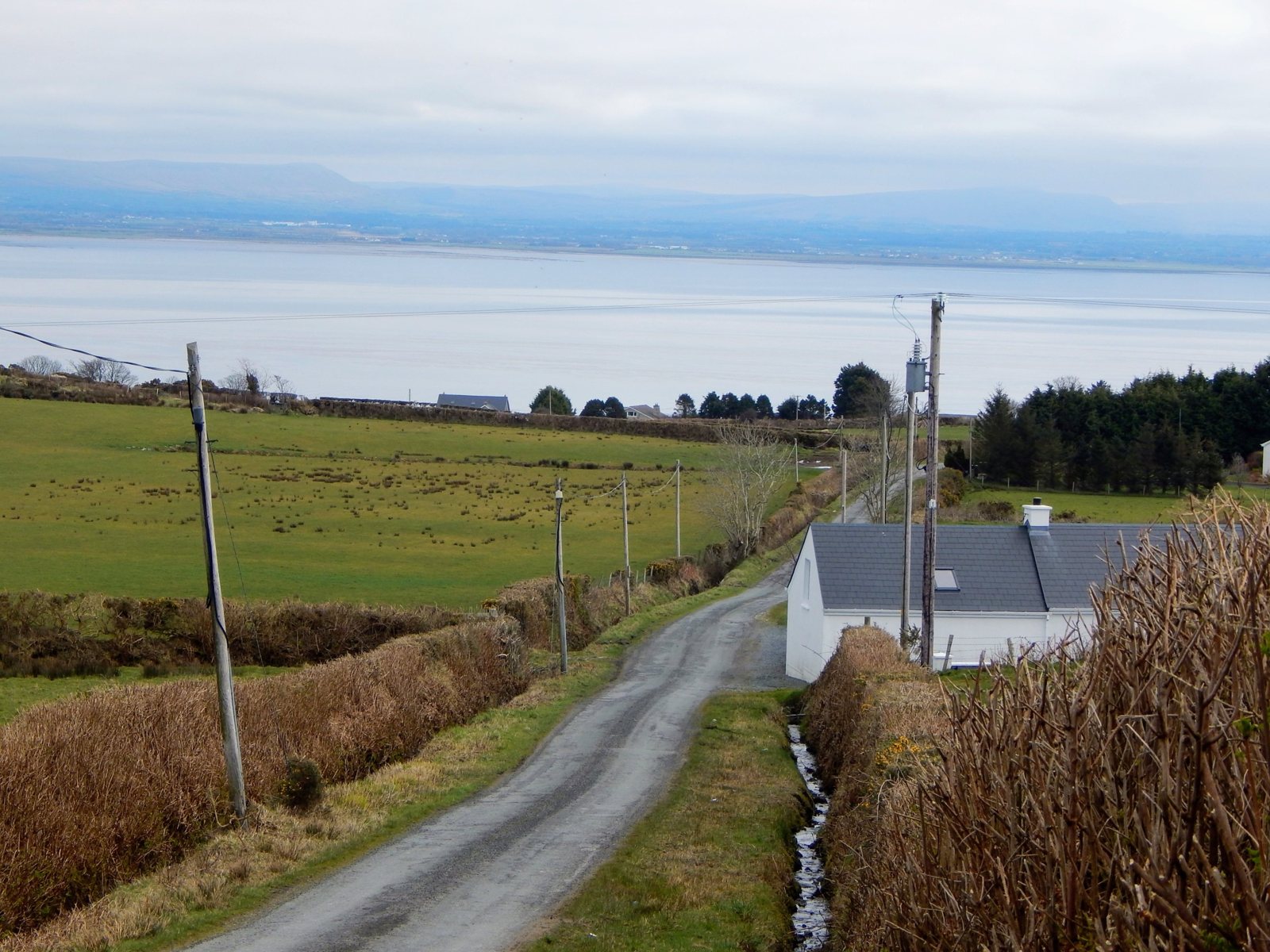
The farm stayed in the family for most of the twentieth century. After partition many Protestant families in Donegal moved across the new border, and some years after my father was born at Ballyrattan in 1933, my grandparents left for Ballynagard, on the Derry side of the line, a few miles away. My grandfather's brothers, who never married, stayed on the farm for the rest of their lives. After them it passed out of the family in the 1980s, and no McCorkell has lived in the cottage since the middle of that decade.
Robert married Jane Williams on 2 February 1857 at the new Presbyterian church in Moville, by the Rev. A. Clements; the Londonderry Sentinel announced "Mr. Robert McCorkell, to Miss Jane Williams, Ballyratten". The marriage record names Robert's father as William McCorkell, farmer, of Ballyrattan. The Moville Presbyterian registers record the baptisms of their children: William (1858), Catherine (1860), James (1862), Francis (1865), Joseph (1868), Martha Jane (1871), Robert (1872) and Lewis (1875). The children went to the national school in the townland, Ballyrattan and Castlecary, whose registers record James and Francis starting in 1871, Joseph in 1873, Catherine in 1874, Robert in 1878 and Lewis in 1881. Three emigrated in later years, probably following earlier generations of the family. James sailed on the Polynesian in 1886 and settled at Victoria, on Vancouver Island, where he married Jane Freebairn Anderson in 1894 and the census takers spelt the family McCorkall. Francis went to Boston in 1888 and married Isabella McKinnon at Cambridge in 1892. Catherine went to the Boston area too, and on 1 June 1891 she married William G. Dwyer at Cambridge, Massachusetts, the record naming her parents as Robert and Jane.
Robert stood for the townland in public life too. In June 1892 a meeting at Moville chose him, as "Robert M'Corkell, Ballyrattan", as one of the district's delegates to the Ulster Unionist Convention in Belfast.
One other McCorkell boy appears in the school register, and for a while he was a puzzle. John McCorkell joined the infants' class in 1887, from Ballyrattan, his parent entered as a widow and his church as the Church of Ireland, not Presbyterian like Robert's children. He was the son of Archibald McCorkell of the Greencastle family and Agnes Douglas, and he had been born at Boston in March 1880, a few months after his parents' marriage at Greencastle. His father died in Boston in 1883, and his mother brought him home to her own people, the Douglases of Ballyrattan, whose children sit beside him in the register. As a young man he went back to Boston.
Jane Williams knew the cost of emigration. In February 1847 her family sailed from Londonderry for Quebec on the Helen Thompson, and the family believed that her parents and four of her brothers and sisters died in the fever that swept the immigrant ships and quarantine camps that year. Jane remained in Ireland, and nothing was heard of the others again.
William McCorkell, 1807–1892
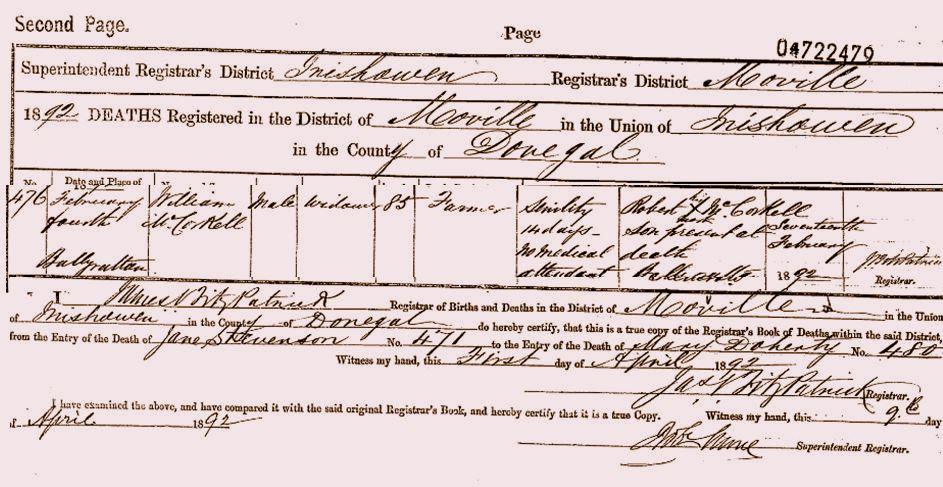
Robert's marriage record names his father as William McCorkell. William was born about 1807; there is no baptism, since the Moville Presbyterian registers only begin in 1833, and his age comes from his civil death record. He died at Ballyrattan on 4 February 1892, aged 85, with his son Robert at his side.
William married Sara, known as Nancy, Wray about 1830. Robert, my great-great-grandfather, was born about 1831, before the Moville Presbyterian registers begin in 1833. The registers then record the baptisms of Margaret (1834), Nancy (1842), Mary (1844), Esther (1845) and Martha (1848), though there were probably more. Four of his daughters, Margaret, Mary, Martha and Nancy, emigrated and settled at Victoria, British Columbia; their journeys are told in Chapter VII. The proof that they were William's daughters is a marriage at Victoria on 25 January 1873, when Martha McCorkell married William Harrison: the record names her parents as William and Ann McCorkell, Nancy being the familiar form of Ann. Their sister Esther stayed at home and married Thomas Baird at Moville in 1874. A son, James, born in the early 1840s, went to Massachusetts, married Mary Baird at Boston in 1868 and was a labourer at Cambridge, where their children were born. Another daughter, whose name I do not know, died in a tragic accident on the farm:
On Friday last, a girl, nine years of age, daughter to William M'Corkell, of Middletown, Ballyratten, near Moville, was gathering weeds as fodder for a cow. The child placed them in a creel, a custom common in the country, and had secured it by a strap across her shoulders. Having rested her burthen on a ditch, the creel, by some mischance, became overbalanced, and, the cord tightening round the neck of the little girl, she was unfortunately strangled.Northern Whig, July 1845, reprinted in the Ballyshannon Herald, 11 July 1845
Her name is not given, and she is hard to place. A girl of nine in 1845 would have been born about 1836, yet no such baptism appears in the Moville Presbyterian register, and all of William's later daughters are accounted for. Either the newspaper had her age wrong and she was born before the register begins in 1833, or her baptism was simply never recorded.
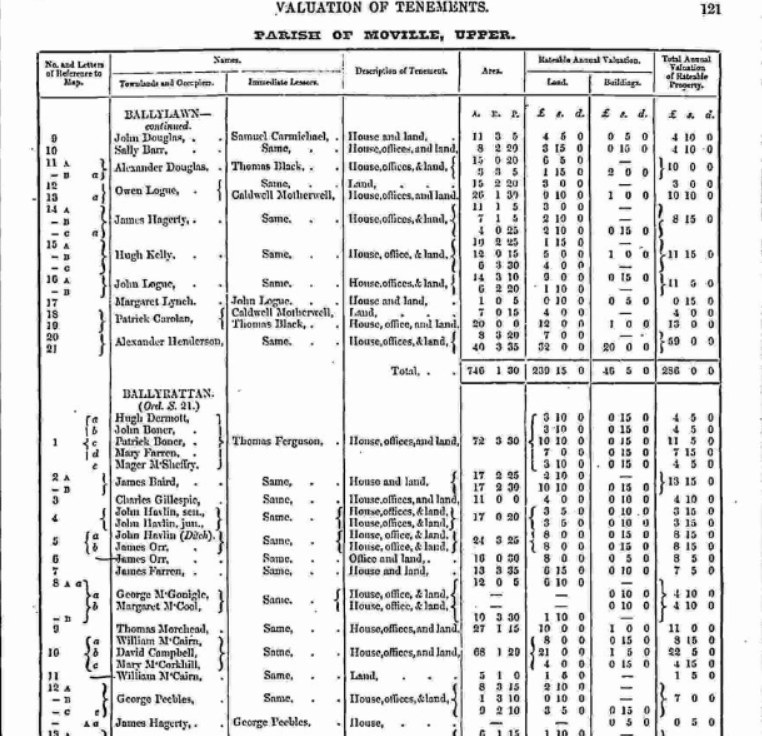
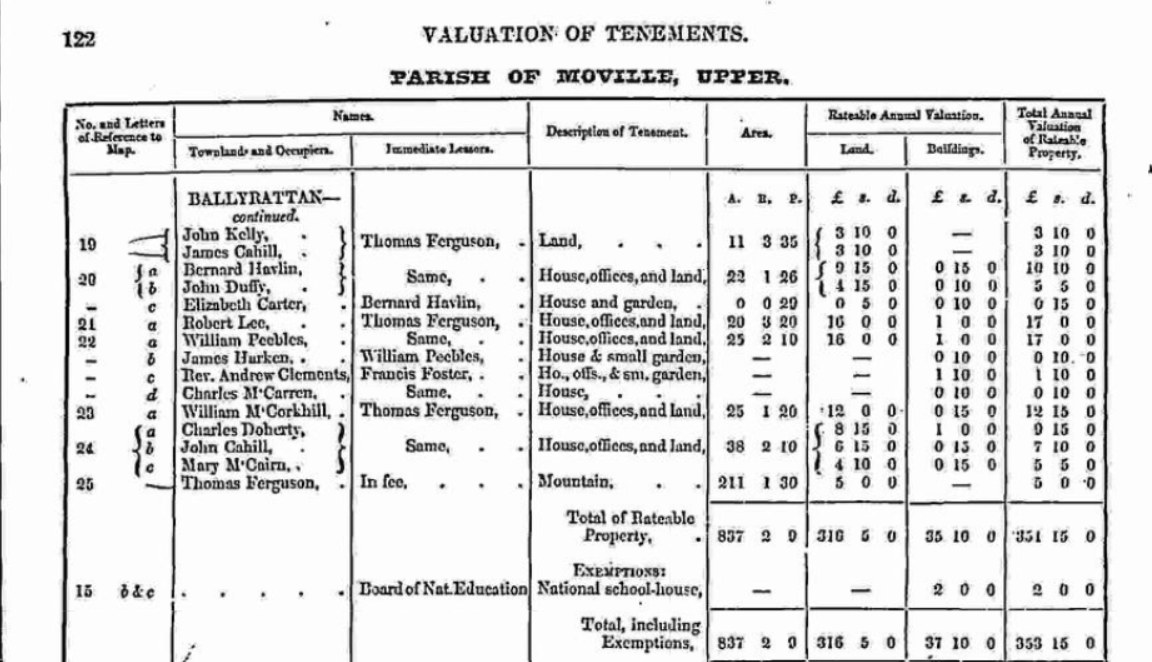
In Griffith's Valuation of 1857 William M'Corkhill holds lot 23, a house, offices and just over 25 acres, valued at £12 15s, from the landlord Thomas Ferguson. Listed just before him, at lot 22, is the Rev. Andrew Clements, the Moville minister who married William's son Robert to Jane Williams that same year. A second McCorkell holding is listed in the name of Mary M'Corkhill: lot 10c, her share of 68 acres farmed jointly with William M'Cairn and David Campbell, her land and house valued together at £4 15s, under the same landlord, Thomas Ferguson. She was almost certainly William's widowed mother, Mary Ann, who died at Ballyrattan on 18 June 1871. Shared holdings like hers are a late trace of the old rundale system.
Robert McCorkell, c. 1775–by 1857
Mary Ann's husband, I believe, was Robert McCorkell, recorded in the Tithe Applotment Book for Moville in 1828. He farmed in partnership with several others in the rundale fashion still common in Ireland in the eighteenth and early nineteenth centuries. He was dead by 1857, when Mary Ann held the land in her own name. A Mary Ann McCorkell of Moville sailed for Saint John with a John McCorkell in 1853 (Chapter IV), and it has been suggested that she was Robert's widow, but nothing in the record ties her to Ballyrattan.
The houses stood together in clachans rather than on the farms: Faltransa, the largest in Ballyrattan, and the smaller Middletown, where the family lived. The curate of Upper Moville, Stewart Marks, described the parish for the Ordnance Survey in the 1830s:
The farms all various in size, but in general all small and scarcely any enclosures at all, as the greatest part of them are occupied in rundale. The method of cultivation is such as might have existed 2 or 3 centuries ago … the cabins at present are generally built in a cluster which is a continued source of contention, from their cattle, fowls etc. trespassing on each other.Ordnance Survey Memoirs, parish of Upper Moville, 1830s
He found the people "poor to a great degree" and "inclined to industry", living on potatoes and, when they fared better, herrings. Within a generation the rundale lands had been divided into separate farms, and by the 1850s there were two McCorkell farms in Ballyrattan: William's, which stayed in the family until the 1980s, and an older holding nearby, where the last McCorkells lived in the 1880s.
William McCorkell of Curraghnagarry, c. 1750–1827
I first suspected Robert's father was another William from the Flax Growers' Bounty list of 1796, where a William McCorkell appears for Moville Upper, the only McCorkell in the parish. The list goes no lower than the parish, so I needed more proof. It came a few years later with a cess list for Moville Upper dated 1792, in which William McCorkell appears in Curraghnagarry, a subdivision of Ballyrattan.
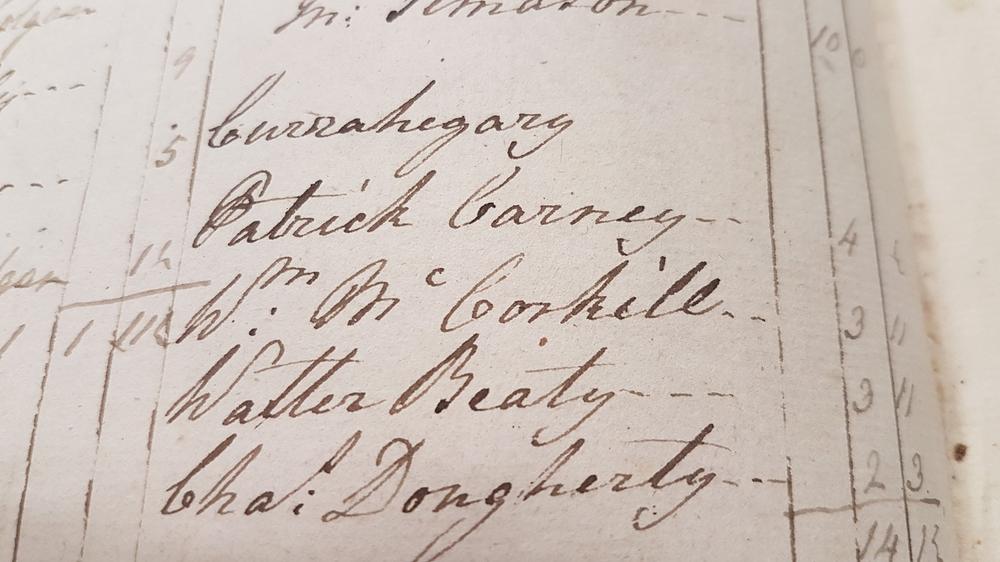
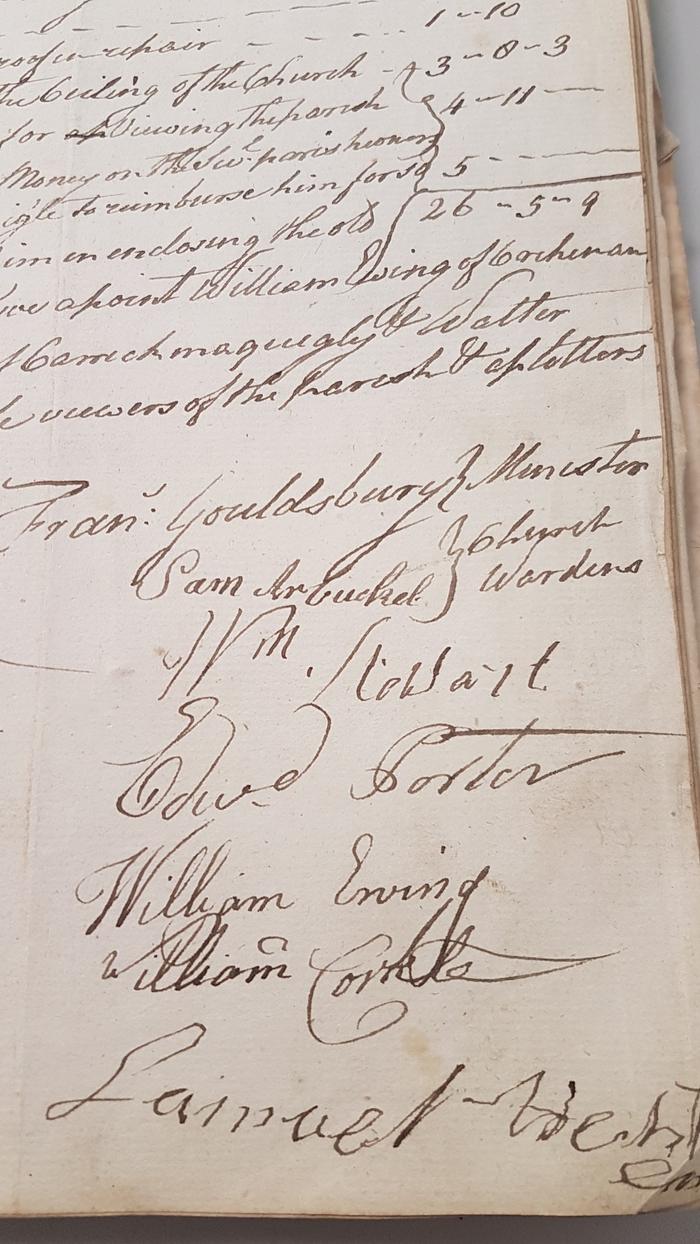
In the same year William served as churchwarden of the parish church of Moville, a position of some responsibility, and he signed the vestry minutes as "William Corkle". In the early 1800s he appears to have paid for his own pew there. That does not mean the family were Anglican. The vestry also handled civil business such as the county cess, and Presbyterians could serve on it; a historian at PRONI confirmed this to me, and all later members of the branch remained Presbyterian.
Before William
Beyond William I am speculating. No McCorkells appear in Ballyrattan before him, but a Robert McCorkell appears on a tithe list for Moville in 1774, in the same vestry book. He lived at Ballymacarthur, about four miles north of William, and was the only McCorkell in the parish. The naming pattern fits. I believe he is either the Robert McCorkell who appears at Ballymacarthur in the 1740 Protestant census, or more probably his son, since the Robert of 1740 must already have been an adult. The McCorkells of Ballymacarthur are probably my direct ancestors, and the name survives there today in McCorkells Road, Bóthar Mhic Thorcaill, near Greencastle (pictured in Chapter I). How and when the family reached Moville is discussed at the end of Chapter II.
One estate, two townlands
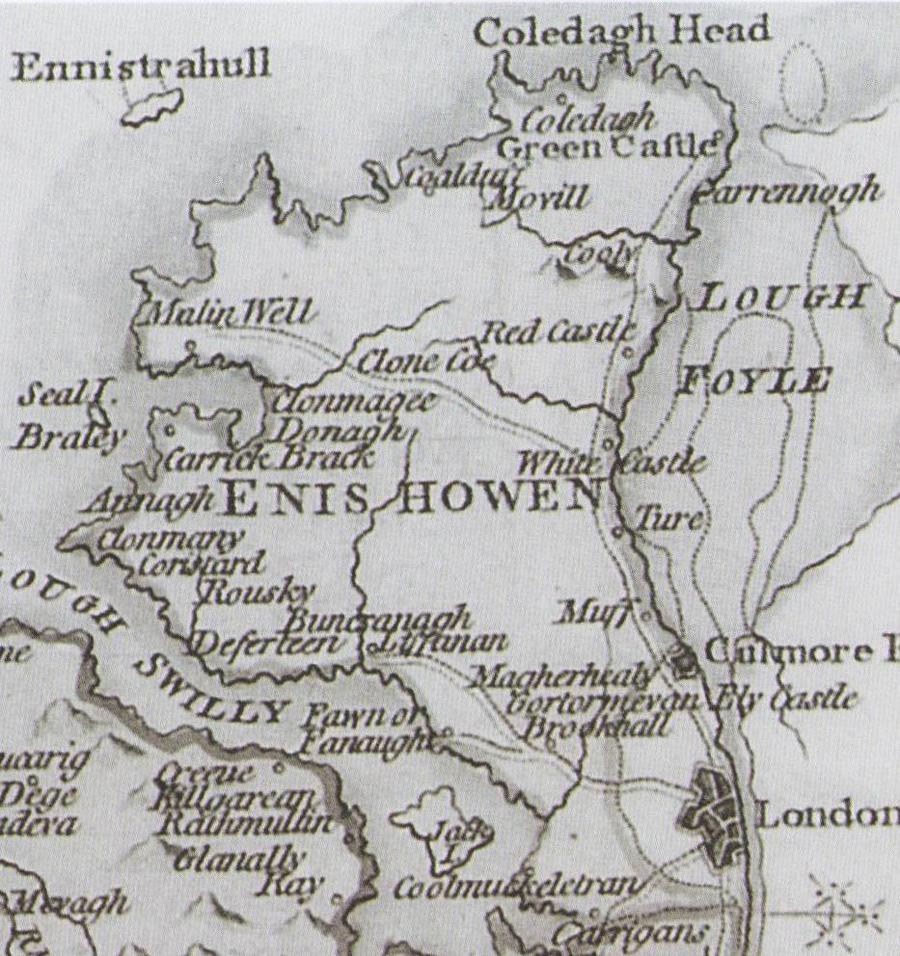
Ballyrattan and Ballymacarthur were not just neighbours. For most of the eighteenth century they were part of one leasehold estate, held from the Earls of Donegall, as the deeds in the Registry of Deeds show. By 1709 John Rankin of Greencastle held, under a lease of 1691, a block of land around Greencastle: Shrove, Carrowtrasna, Ballymacarthur, Ballylehan and Tardrum, the ferry at Greencastle, and further south Clare, Meenletterbeal and “two tryans of Curraghogary” and “two tryans of Ballyrattan”. In 1724 and 1725 his sons, Henry, a sailor, and John, a dragoon, sold their halves to William Jackson and Edward Cary of Red Castle, and the Cary family held the lands for the rest of the century, until George Cary made them over to Charles McIntire in 1797.
The deeds name the landlords, mortgagees and witnesses, but not the farming tenants, and no McCorkell appears in them. The earliest people named as living at Ballyrattan are William Spence, who took a lease of the two tryans in about 1720, and Edward Spence “of Ballyrattan”, a witness in 1747.
The cess list of 1792 in the Moville Upper vestry book, which I transcribed myself, has two McCorkells: William at “Curraghegary (Part of Ballyrattan)”, assessed 3s 11d, and Archibald McCorkill at Cooley, the next townland, assessed 11d. Archibald’s link to William is unknown. Twenty-five years earlier, in 1767, William McCorkel, the Derry innkeeper, had witnessed the sale of the half quarterland of Lower Cooly (see the Shipping McCorkells). Whether that has anything to do with Archibald being there in 1792 is also unknown.
My belief is that the McCorkells were tenants first at Ballymacarthur, where Robert is recorded in 1740 and 1774, and that a son took up a vacant lease at Ballyrattan on the same estate, with a relative at Cooley nearby. This is inference: the threads are loose, but they all lead the same way, and a single lease or rental of the Cary estate could confirm or overturn it.
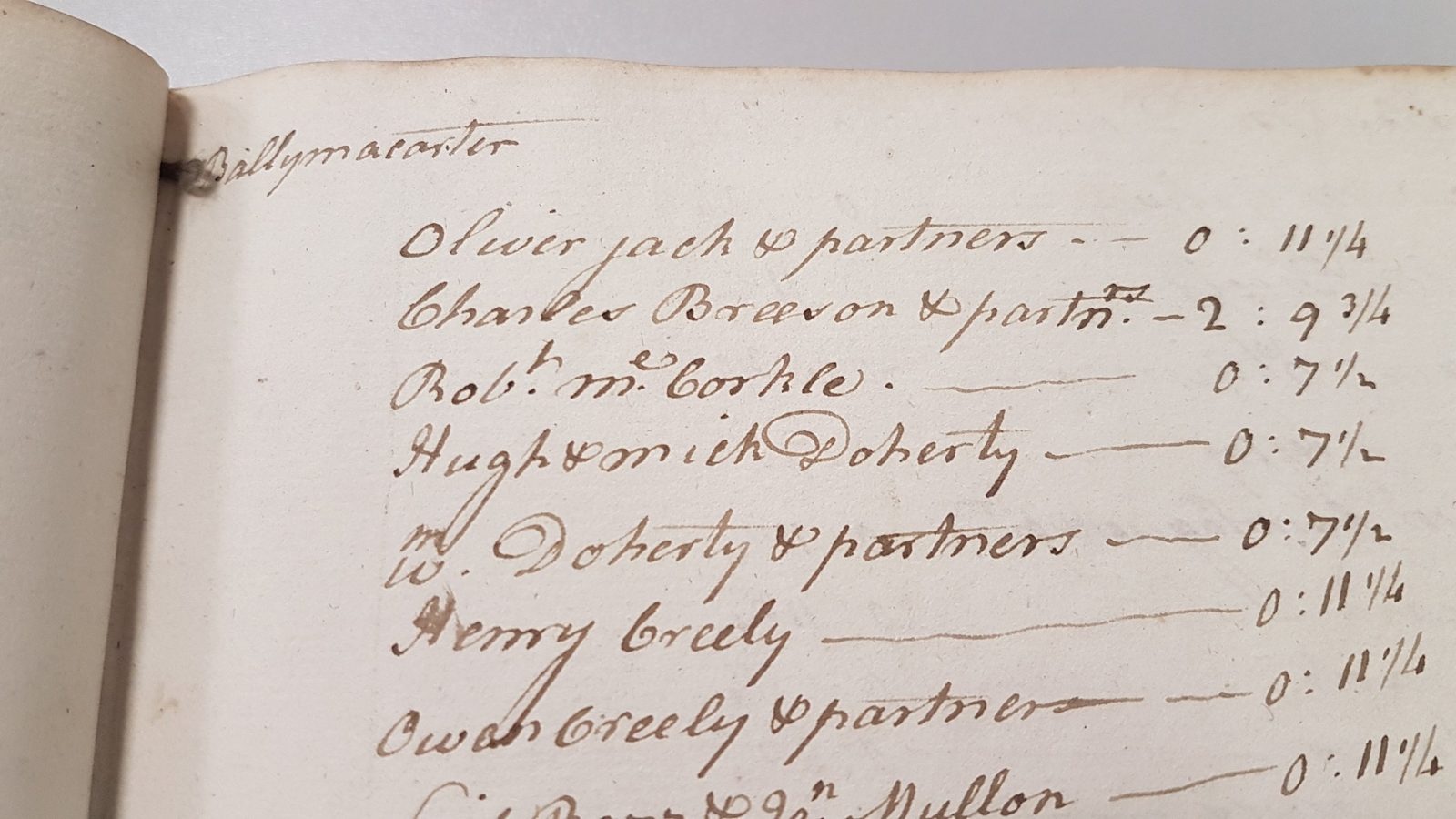
This Robert may be the Robert McCorkle who married a Sarah McCorkell at St Columb's Cathedral in 1727; there is only one Robert in the 1740 census, so it seems a reasonable guess. (From Viking Glory, Louis W. McCorkle's 1982 family history, gives this marriage as Robert and Mary McCorkell on 10 September 1727, by Mr Southeby; the register itself reads Sarah.) If so, it shows a marriage between two McCorkell branches at an early date.
Open questions
- Does a rental or lease book of the Cary estate (Redcastle and Castle Cary) survive, and does it name the McCorkell tenants at Ballymacarthur, Ballyrattan and Cooley?
- Who was the girl of nine who died at Middletown, Ballyrattan, in 1845?
- Robert and Mary McCorkell, married at St Columb's in 1727: From Viking Glory gives the bride as Mary, the register as Sarah. Was Robert the Robert of Ballymacarthur?
- How were William of Ballyrattan (1807–1892) and William of Greencastle (c. 1815–1895) related? See Ballymacarthur and Greencastle.
Sources
- Census of Ireland, 1901, National Archives of Ireland (census.nationalarchives.ie).
- Civil registration, Moville: marriage of Robert McCorkell and Jane Williams, 1857; death of William McCorkell, 1892.
- Griffith's Valuation, Moville Upper, 1857.
- Moville Presbyterian registers, baptisms from 1833.
- Moville parish vestry book: cess list and signatures, 1792; tithe list, 1774.
- Registry of Deeds, Dublin, memorials of deeds concerning the Rankin and Cary estate, 1709–1797 (FamilySearch full-text transcripts).
- Tithe Applotment Book, Moville, 1828, National Archives of Ireland.
- Northern Whig and Ballyshannon Herald, July 1845.
- Londonderry Sentinel family notices, 1845–1865, transcribed by Len Swindley (cotyroneireland.com).
- Louis W. McCorkle, From Viking Glory: The McCorkle Family (1982), pp. 30–33 and notes.