Burt is where the McCorkell story in Ireland is densest: the Laggan Army muster of 1643 at Elagh, the kirk session baptisms of the 1670s, the 1740 census at Carrownamaddy, Speenoge and Mulleny. Farming families of the name were still there in the nineteenth century, in the townlands of Elaghbeg, Skeog and Dundrain.
| Year | Townland | Record |
|---|---|---|
| 1824 | Carrowreagh | “A M’Corkell, Manustown” and “J M’Corkell, do.” subscribe to George Dugall’s poems, The Northern Cottage. Manustown is Manner’s Town, a small village in Carrowreagh on the Ordnance Survey six-inch map. |
| 1837 | Elaghbeg | Archibald, William and Samuel McCorkell in the tithe applotment. |
| 1837 | Skeog | John McCorkell in the tithe applotment. |
| 1837 | Dundrain | James McCorkell in the tithe applotment. |
| 1850 | Skeog | Mary Jane, youngest daughter of John McCorkell, Esq., of Skeagh, marries John A. Graham, saddler, of Coleraine, at the Second Presbyterian Church, Dunboe. |
| 1857 | Elaghbeg | Robert McCorkell holds 65 acres in Griffith's Valuation. |
| 1857 | Dundrain | James McCorkell holds 72 acres in Griffith's Valuation. His son Thomas marries Sarah Eliza McElveny at Fahan Presbyterian Church the same year; another son, James, remarries in 1885, and a daughter, Mary, marries Hugh MacMurtree in 1873. |
| 1858 | Carnamaddy | Mary McCorkell of "Carsamaddy" marries S. Robinson of Bonnemaine at Crossroads Presbyterian Church. |
| 1860s | Burt | Samuel McCorkell, prize-winning dairy farmer. |
| 1872 | Carrowreagh | David McCorkell, labourer, aged 50, of Carrowreagh, marries. |
An Archibald McCorkle paid hearth money at Elaghbeg in 1665, and an Archibald McCorkell is there again in the tithe of 1837. The same name on the same townland 172 years apart suggests a family that never moved. Lecky noticed the same thing in the Laggan in 1905: families of the old names still living on the old townlands.
At Dundrain, James McCorkell and Mary Ann Adams raised Thomas (b. 1835), James (b. 1839), Margaret and Matilda, two of whom married McElvennys. At Carrownamaddy, where “Arsbel” (probably Archibald) McCorkle was a Protestant householder in 1740, William McCorkill, born about 1810, farmed at the time of Griffith’s Valuation. He married Mary Robertson; their daughter Mary married S. Robinson in 1858, and Dorcas, born about 1844, married Samuel Doak of Londonderry at Burt Presbyterian Church and raised ten children in Burt and then in the city. Two Dundrain boys who emigrated seem to have called themselves Derry men abroad: Samuel, son of James McCorkell and Sarah Edwards, born on 1 January 1880, is very probably the Samuel McCorkell "born 4 January 1880, Derry, Ireland" of a 1917 American draft card, and Joseph, son of Thomas McCorkell and Sarah Eliza McElveny, born on 1 December 1878, probably the Joseph McCorkell "born 3 December, Londonderry" of later Canadian and American records. The day and month match; the years are a little out, as emigrants' own ages so often are.
The kirk session book of 1670–1715 is full of the name (Chapter II). An American researcher has noted that its index “reads like a telephone directory” of eighteenth-century Augusta and Rockbridge counties, Virginia.
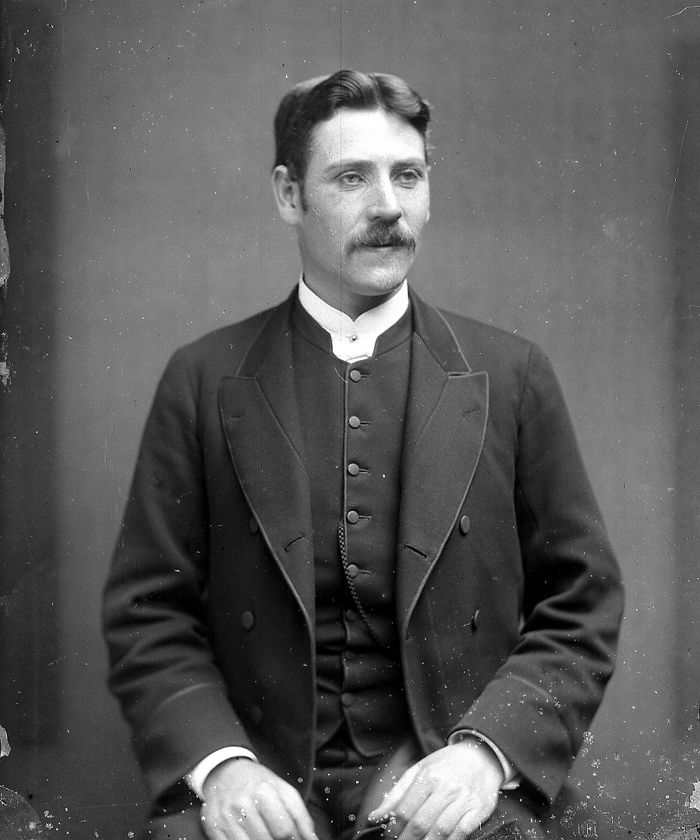
Rev. Joseph MacCorkell
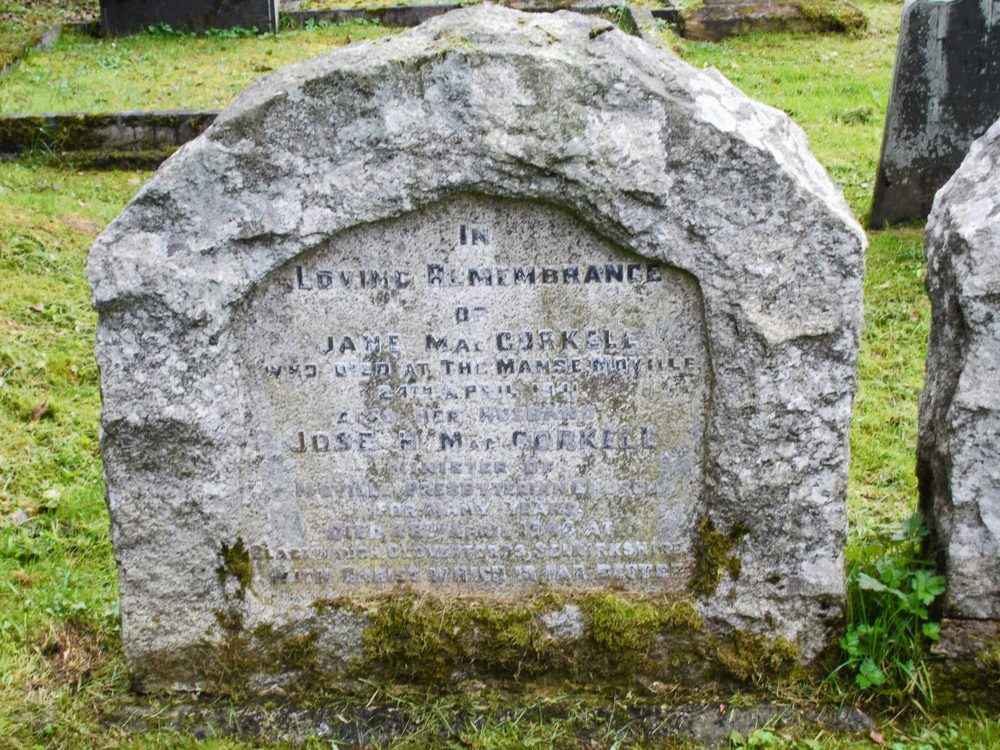
Joseph McCorkell (1857–1944) came from this Burt farming family. He was the son of John McCorkell and Mary Ann Fleming, and grandson of John McCorkell (1810–1873), who farmed 108 acres at Skeog in the tithe of 1837. His uncle Samuel (1842–1873) married Mary Jane Hanna, and his aunt Mary Jane (1847–1908) married Daniel Rankin; his own brothers and sisters included Martha Louisa (1866), Samuel James (1869) and Willamina Jane (1871). He entered the Presbyterian ministry and was for many years minister of Moville, where, by a strange twist, he baptised my grandfather in 1909 and my father in 1933, though he was not of our direct line. In later records he spelt his name MacCorkell. He had one daughter and no male descendants, and he is buried at Clar burying ground in Upper Moville, the same graveyard as my great-grandfather. His wife Jane died at the Manse in Moville on 24 April 1941, and Joseph died three years later, in April 1944, at Blackhaugh, Clovenfords, in Selkirkshire, but he was brought home to lie beside her at Clar.
His photograph, and one of a Mrs McCorkell of Skeog, survive in the collection assembled on the shipping family. Families kept the likenesses of people they counted as kin, and I believe the Shipping McCorkells came originally from Burt. If so, the city merchants and the Burt farmers were cousins, and both lead back to the kirk session McCorkells of the 1670s.
Open questions
- Was Martha Louisa McCorkell of Killea, who married William Glenn in 1888 aged 21, the Martha Louisa born at Burt in November 1866, sister of the Rev. Joseph? If so, the Killea family and the Skeog family were one. The marriage entry should name her father.
- Did the Shipping McCorkells come originally from Burt? See the Shipping McCorkells.
- Can the Dundrain, Skeog and Elaghbeg families be linked back to the kirk session baptisms of the 1670s?
- Who were A. and J. M’Corkell of Manner’s Town in 1824, and were they the forebears of the Carrowreagh McCorkells of 1872 and 1901?
Sources
- Census of Ireland, 1901, National Archives of Ireland (census.nationalarchives.ie).
- Tithe Applotment Book, Burt, 1837, National Archives of Ireland.
- Griffith's Valuation, parish of Burt, 1857.
- Burt Kirk Session Book, 1670–1715, extracted by Oliver D. Cresswell (1995).
- Marriage notice of John A. Graham and Mary Jane McCorkell, 1850.
- Headstone of Jane and the Rev. Joseph MacCorkell, Clar burying ground, Upper Moville, photographed by Joe McCorkell.