This chapter is still being written. The emigrant families themselves are followed in Chapter VII. If your family is American, start with McCorkle family history: from Ulster to America.
Why they left
Ulster Presbyterians left for the New World partly to escape the Sacramental Test and their exclusion from public life, described in Chapter III. That is one valid view, but there were other factors just as important. Many of the cheap leases that had drawn Scots to Ulster a century earlier were expiring, and landlords raised rents steeply. Bad harvests and slumps in the linen trade added to the pressure. By the middle of the century many thousands of Ulster people were crossing the Atlantic every year.
1718: the first great emigration
The first great emigration of Ulster Scots, almost all Presbyterian, came in 1718. The best-known group left the Bann valley in County Londonderry and founded the town of Londonderry in New Hampshire. A large group from the Laggan, where Burt Presbyterian church stands, followed close behind and settled around Casco Bay in Maine, then part of Massachusetts.
The Laggan already had a link to America. Francis Makemie, who preached at Burt in 1682, went on to found the Presbyterian church in America, and families from the congregations he knew followed the same road.
Several McCorkells emigrated in the 1720s, and others in every decade after. If my own family is anything to go by, there was a steady stream that continued until the early 1900s. Philadelphia appears to have been the family's favourite port of entry, from the mid-1700s until the early decades of the twentieth century.
What the DNA tells us about the emigrants
Where the ship lists fail, the Y-DNA helps. Men descended from these eighteenth-century emigrants have tested with the McCorkle surname study, and their results match those of McCorkells still in Ireland. Their earliest known ancestors include:
| Earliest known ancestor | Where recorded |
|---|---|
| Matthew McCorkle, b. about 1720, d. after 1777 | — |
| Alexander McCorkle, b. 1725 | Ireland |
| John McCorkle, 1734–1810 | Died Mecklenburg County, North Carolina. Two testers descend from him, and their trees disagree on whether he was born in Ireland or in Pennsylvania. |
| Thomas McCorkle, b. about 1750 | Pennsylvania |
| Archibald McCorkle, b. 1772 | — |
| John McCorkle, 1789–1881 | Tennessee |
The pattern is the classic Scots-Irish one: landing at Philadelphia, settling first in Pennsylvania, then moving down the Great Wagon Road into the Carolinas and on to Tennessee. Several of these men share SNP mutations, BY72575 and BY156610, that mark them as one American branch descended from a single emigrant ancestor. An Alexander McCorkle of Northern Ireland, b. 1725, d. 1780, sits on a separate branch, as I expect the Donegal lines will. A Big Y test of a Donegal McCorkell would show where the Irish and American lines divide. See Chapter VI.
Paper evidence of the decision to leave is rare. One glimpse is the Abercorn agent's letter of 1783 about William McCorkill of Cloughfin, who sold his farm as young men of the district were setting out for America with their linen (Chapter III).
Arrivals at Philadelphia
Philadelphia's own records list several McCorkells among the passengers landing there in the early nineteenth century:
| Name | Ship | Arrived |
|---|---|---|
| Elizabeth McCorkle | Maria | 3 Nov 1804 |
| Archd. McCorcle | Eliza | 12 May 1812 |
| Robert McCorkle | Columbia | 3 Oct 1817 |
| Wm. McCorkell | Delaware | 8 Jul 1819 |
The lists do not say where the passengers came from, but most ships into Philadelphia in these years sailed from Ulster ports, Londonderry among them.
The passenger books
By the nineteenth century records improve. The Derry shipping agents, among them J. & J. Cooke, kept passenger books recording each emigrant's name, residence, passage money and the "earnest" paid to secure a berth.
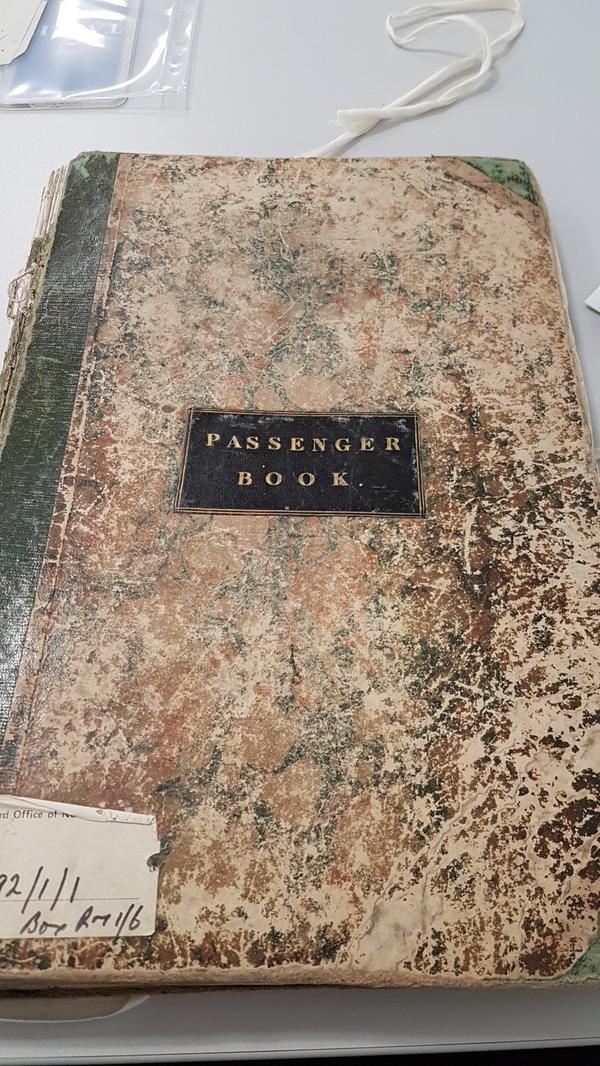
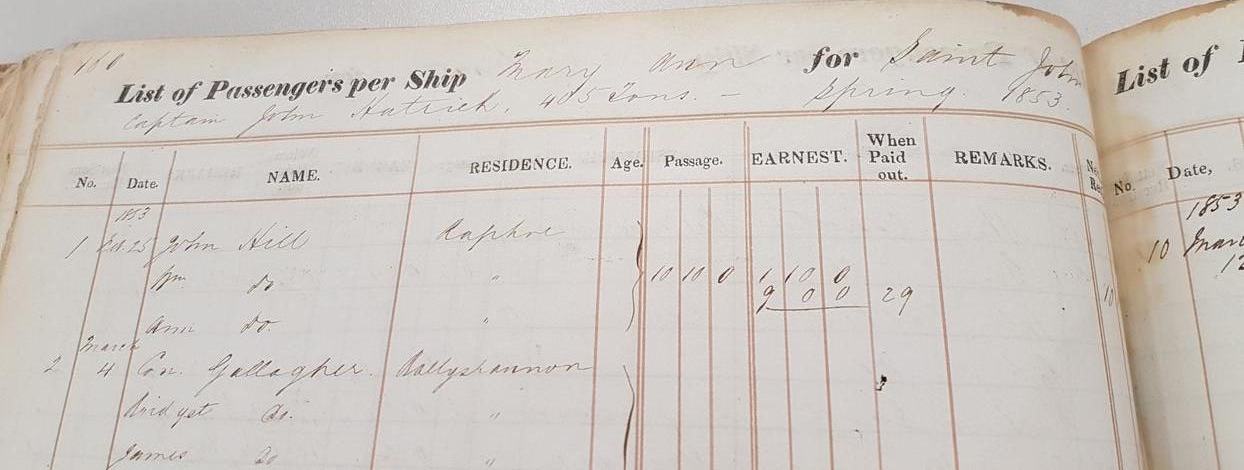
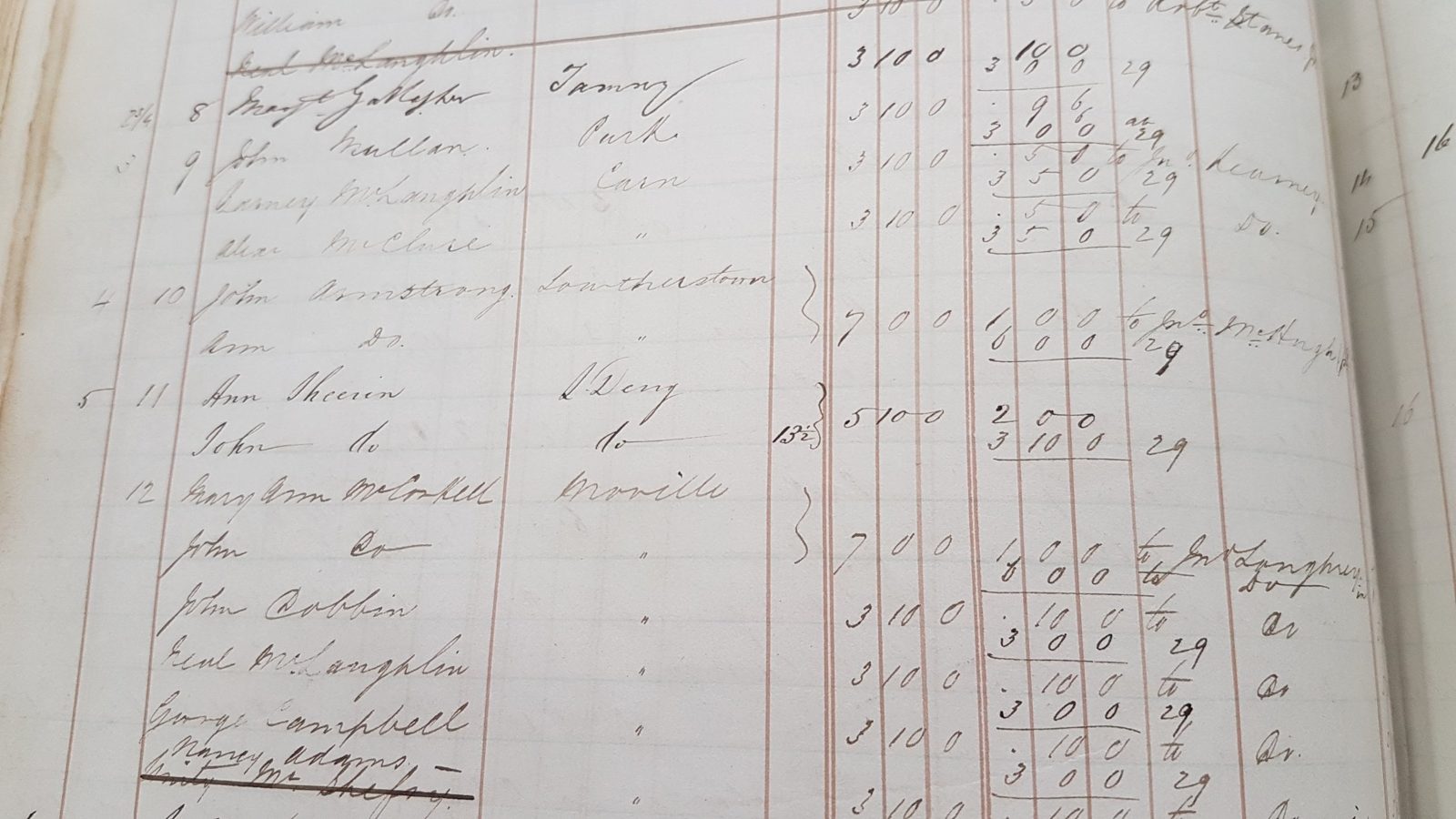
The passage money was £3 10s a head, and the earnest, a deposit paid to secure the berth, appears to be noted against the name of an agent. The ledger gives no ages and does not say how the two were related. The entry gives only Moville. A family tradition placed them at Ballyrattan, as Mary Ann, the widow of Robert, and a son, but no record links them to the townland, and John and Mary Ann were both common names among the Moville McCorkells. I would be glad to hear from anyone who knows more.
To Australia
In the nineteenth century Australia became a destination too, first for assisted immigrants in the 1840s and then for the gold rushes of the 1850s. The families who went, from Buncrana, Ballynagard, Monellan and Derry, are followed in Chapter VII; the arrivals found so far in Victoria are listed here.
McCorkells landing in Victoria
| Name | Born about | Ship | Arrived |
|---|---|---|---|
| Duncan McCorkell | 1828 | Glentanner | Sep 1853 |
| Margaret Jane and Samuel McCorkell | 1837, 1830 | Poictiers | Jan 1854 |
| Catherine McCorkell | 1835 | Black Eagle | Oct 1854 |
| George McCorkell | 1844 | Red Jacket | Dec 1864 |
| Elizabeth, John and William McCorkell | 1833, 1836, 1841 | City of Agra | Feb 1871 |
| Alexander McCorkell | 1851 | Loch Ness | Mar 1872 |
| George Magee McCorkell | 1859 | Shannon | Nov 1881 |
| John James McCorkell | 1851 | Liguria | Dec 1886 |
| Andrew McCorkell | 1868 | Oriental | May 1892 |
| Jane McCorkell | 1888 | Indrapura | May 1914 |
| Mary McCorkell | 1899 | Sophocles | Jan 1923 |
George Magee McCorkell was a son of the younger Archibald McCorkell of Derry and Elizabeth Chambers Magee, born in Shipquay Street on 11 February 1859; he died at St Kilda on 8 December 1881, aged 22. Another Eliza or Elizabeth McCorkell, born in the 1820s, married George Stewart in Victoria and had a daughter Mary in 1849.
The families of the nineteenth century, including the Ballyrattan McCorkells who went to Boston, Vancouver and Victoria, British Columbia, and the Loughgilly brothers who sailed for Philadelphia in 1851–53 and homesteaded in Minnesota and Iowa, are followed in Chapter VII, and their homes in Chapter V.
Sources
- McCorkle Surname DNA Study and Little Scottish Cluster project, FamilyTreeDNA.
- Abercorn estate papers, PRONI (D623).
- Derry shipping passenger books, PRONI.
- Passenger Arrivals at the Port of Philadelphia, 1800–1819.
- Victorian immigration and registration records, compiled by an Australian correspondent.